


Established
2016
Franchise Units
65
Minimum Investment
₹ 20,00,000
Franchise Fee
₹ 3,00,000
Total Investment Range
₹ 30,00,000
Home Based
No
Description
The Indian Quick Service Restaurant (QSR) segment has seen massive shifts over the last decade. While global giants brought the concept of fast-food burgers to the country, there remained a distinct, empty space for authentic, bold, and unapologetically Indian flavors. Enter Wat A Burger—a homegrown phenomenon that successfully bridged the gap between high-quality Western fast food and the rich palette of Indian street flavors.
From its inception, Wat A Burger carved out a unique market positioning: premium, high-quality, gourmet-style fusion burgers served at prices that appeal directly to India’s massive millennial and Gen-Z demographic. Unlike standard international chains that rely on uniform, uninventive menus, Wat A Burger built its reputation on culinary innovation. With crowd-favorites like the Chicken Makhani Burger, Peri-Peri Chicken, and Aloo Achari, the brand offers a comforting familiarity wrapped in a fast-casual modern format.
Today, Wat A Burger stands as one of the fastest-growing native burger chains in India. Its consumer appeal lies in its uncompromising quality—using fresh ingredients, soft artisan buns, and proprietary sauces—while maintaining an affordable average ticket size. For an investor, the brand represents a highly stable, high-margin asset in a food tech-driven ecosystem, benefiting heavily from robust dine-in traffic and high-volume online deliveries via major food delivery apps.
Background
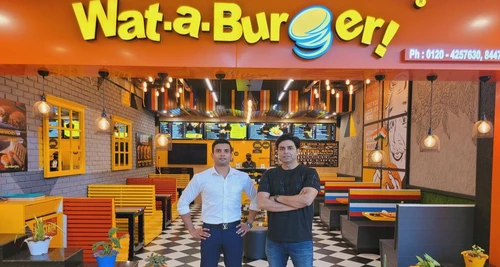
Wat A Burger was founded in 2016 in Noida, Uttar Pradesh, by childhood friends and entrepreneurs Rajat Jaiswal and Farman Beig. The story behind its inception is unique: Rajat, a commercial airline pilot with thousands of flying hours, wanted to establish a stable, non-volatile venture rooted in his passion for food, while Farman brought his sharp business acumen as CEO to scale the operational side.
Company Name: Bigbuns India Private Limited
Brand Name: Wat A Burger
Established Year: 2016
Founders: Rajat Jaiswal & Farman Beig
Industry Category: Food & Beverage / Quick Service Restaurant (QSR)
Current Active Units: 65+ active outlets across more than 26 cities in India.
Brand Evolution: Starting as a single pilot outlet where the founders offered money-back guarantees to ensure customer satisfaction, the brand quickly expanded across the National Capital Region (NCR) and gradually penetrated major markets across North, Central, and North-East India. It operates through a mix of company-owned and franchise-operated units, establishing a major presence in both metropolitan food hubs and growing semi-urban markets.
Support Training
Wat A Burger provides comprehensive, end-to-end support to ensure franchise partners can mirror the brand's operational excellence from day one.
Pre-Launch Support
Site Selection & Location Analysis: Complete data-driven analysis of local footfall, competitor density, and catchment potential to lock in the perfect location.
Interior Design & Layout Engineering: Providing standardized, ergonomic blueprints optimized for maximum seating capacity and rapid kitchen workflow.
Vendor and Equipment Sourcing: Assistance in procuring specialized kitchen equipment, POS systems, and cold storage units directly from verified, cost-effective vendors.
Operational & Staff Training
Academic & Kitchen Training: Comprehensive training programs for the kitchen staff, covering exact portioning, food hygiene, assembly line processes, and waste management.
Managerial & POS Training: Onboarding franchise owners or managers on cloud-based billing, inventory tracking software, and daily reconciliation protocols.
Marketing & Tech Integration
Grand Launch Support: Curated hyper-local marketing strategies, social media campaigns, and launch offers to build immediate local buzz.
Aggregator Integration: Seamless onboarding and optimized menu positioning on food delivery portals under corporate pre-negotiated commission structures.
Ongoing Promotional Material: Seasonal menu introductions, festival-centric marketing creative, and digital assets provided by the central marketing desk.
Ideal Candidate
Wat A Burger looks for partners who view food service not just as a financial investment, but as a commitment to customer experience.
Financial Capability: Candidates must have a clean financial record and the liquid capital required to meet the initial capital expenditure and initial working capital cycle.
Business Acumen & Passion: Prior experience in the hospitality or retail sector is highly beneficial but not strictly mandatory. A hands-on entrepreneurial mindset and passion for the food tech industry are essential.
Operational Commitment: The ideal franchisee should be willing to actively oversee store performance or deploy a trusted, professional manager to maintain corporate standards.
Location Preference: The applicant should either own or have the capability to lease a high-footfall commercial space (high streets, premium market complexes, transit hubs, or shopping mall food courts) with a minimum storefront width and clear visibility.
Financial Detail
The financial model of Wat A Burger is structured to offer an accessible entry point into the lucrative QSR segment with a clear path to profitability.
| Financial Component | Estimated Details (INR) |
| Minimum Investment Required | ₹19 Lakhs |
| Total Investment Range | ₹20 Lakhs to ₹30 Lakhs (Depending on store format) |
| Franchise Fee | ₹3 Lakhs to ₹6 Lakhs |
| Space / Infrastructure Requirement | 250 Sq. Ft. – 500 Sq. Ft. |
| Infrastructure & Interior Cost | ₹9 Lakhs – ₹12 Lakhs |
| Kitchen Equipment & IT Systems | ₹4 Lakhs – ₹6 Lakhs |
| Initial Stock & Inventory | ₹1 Lakh – ₹1.5 Lakhs |
| Marketing & Launch Budget | Included in setup package / Localized allocations |
| Working Capital Requirement | Recommended ₹2 Lakhs – ₹3 Lakhs |
| Royalty / Revenue Sharing | Brand retains ~35% on specific models (Franchisee retains ~65% revenue share) |
| Expected ROI Timeline | 1.5 Years to 2 Years |
| Estimated Break-Even Period | 3 to 6 Months (Operational break-even) |