Bagel Franchise Boom: Brands and Investors Expanding
Bagel Franchise Boom: Brands and Investors Race to Capitalize on Breakfast Demand
Bagels are experiencing a major resurgence, and franchisors, investors, and multi-unit operators are moving quickly to capture the momentum. Across the U.S., both startup concepts and long-established brands are expanding through franchising as consumers continue to embrace premium breakfast options.
Industry leaders say shifting population trends helped fuel the category’s rise. According to Jeff’s Bagel Run CEO Jeff Perera, the pandemic changed where people lived, especially as many residents moved out of metro areas in the Northeast. Once they settled in new markets, they realized authentic bagel options were missing, helping demand grow rapidly.
That consumer shift opened the door for a new generation of bagel brands. At the same time, legacy operators such as H&H Bagels launched franchise programs, while regional chains like Barry Bagels renewed their development efforts.
Investors Backing Fast-Growing Bagel Brands
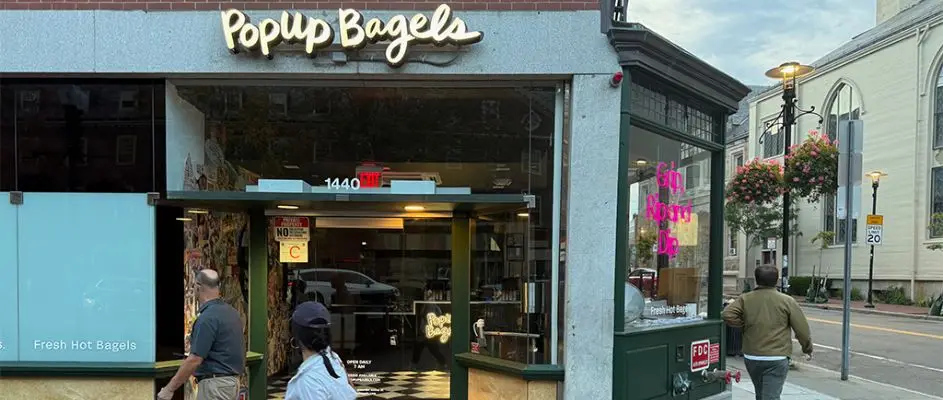
Private capital is now entering the bagel category in a serious way. Recent reports indicated Tiger Global invested in PopUp Bagels at a $300 million valuation, although neither company confirmed the report.
Prior to that, New York-based investment firm Stripes led an $8 million funding round in 2023 and another $27 million raise the following year. PopUp Bagels currently lists 30 stores on its website.
PopUp Bagels Expands Through Franchising
Founded by Adam Goldberg as a pandemic hobby in his kitchen, PopUp Bagels quickly became one of the most talked-about concepts in the category. The company launched franchising in 2024 when it operated eight corporate locations.
To accelerate growth, the brand hired Tory Bartlett, former chief brand officer of Moe’s Southwest Grill, as CEO.
Using the slogan “Not famous but known,” PopUp attracted celebrity supporters early, including Hollywood producer John Davis, former NFL star J.J. Watt, and actor Paul Rudd.
Goldberg reportedly raised around $2 million in 2022 from celebrity and private investors. With additional Series A and B funding led by Stripes in 2023 and 2024, the company moved aggressively into franchise expansion. By last year, Goldberg said the company had approximately 70 investors.
Major Franchise Deals Signed
Experienced franchise operator Kal Gullapalli signed a 30-unit agreement with PopUp Bagels in early 2025. His portfolio already includes Dave’s Hot Chicken, Marco’s Pizza, and VIO Med Spa.
Gullapalli praised the brand’s customer connection, noting PopUp creates highly loyal fans and stands out in the market.
As of last summer, the company had signed agreements for roughly 300 franchised locations.
Goldberg reflected on the company’s growth, saying the brand started from backyard bagel baking and has now evolved into a national expansion story while maintaining its close-knit culture.
A Simplicity-Driven Model
PopUp Bagels has built a business around operational simplicity. The menu focuses only on bagels and schmears. Customers slice their own bagels, and minimum orders begin at three units.
That streamlined approach has impressed franchisees and investors alike. Gullapalli noted the best-performing brands often focus on doing a limited number of things exceptionally well.
According to its previous FDD, startup costs range from $312,600 to $884,150. Typical locations range from 700 to 1,200 square feet, helping keep rent and occupancy costs lower.
Bagel Private Equity Interest Grows
The category’s investment appeal is broadening beyond single brands. Manhattan Funds launched a dedicated Bagel Equity Fund focused on acquiring independent bagel stores nationwide, rebranding them, and scaling them under Go Bagels NYC.
The firm reportedly acquired two Manhattan stores with an initial $5 million investment.
Jeff’s Bagel Run Continues Rapid Growth
Another standout in the segment is Jeff’s Bagel Run, which is opening its 35th location this month.
Founder Jeff Perera again credited population migration trends for helping fuel consumer demand outside traditional bagel markets.
According to the 2026 FDD:
- Single-store investment ranges from $575,722 to $997,972
- Area development agreements range from $596,722 to $1.1 million
For six company stores operating through all of 2025, annual sales ranged from $807,113 to $1,433,298.
The FDD also showed average monthly franchised sales by operating month:
- Month 1 (12 stores): $96,897
- Month 6 (4 stores): $64,170
- Month 12 (1 store): $77,505
Jeff’s ended 2025 with 14 franchise units.
Perera said opportunities in the bagel category remain nearly endless, though consistency remains the biggest challenge for all QSR brands. He emphasized that both product execution and store experience now matter more than ever.
Expanding Beyond Breakfast
At Brooklyn Water Bagel Co., a 20-unit chain, lunch has become a core sales driver. The menu includes deli sandwiches and specialty items alongside breakfast offerings.
CEO Dan Smith said the brand focuses on broad choice through breakfast and lunch sandwiches.
Popular items include:
- Bagel Dog – hot dog wrapped in bagel dough with everything seasoning
- Reuben – available on bagel, bread, wrap, or roll
In Las Vegas, single-unit franchise Abel’s Bagels also leans heavily into deli sandwiches. Founder Nick Pace said lunch helps the brand compete against both breakfast-focused operators and sandwich chains.
Bagels as an Artisan Category
Pace noted that unlike some foods, bagels are difficult and labor-intensive to make at home. He compared them to pizza, saying artisan categories where skill matters are often positioned well for long-term demand.
Brooklyn Water Bagel’s Unique Advantage
Brooklyn Water Bagel believes water quality is central to authentic New York bagels.
Smith, a former New Yorker, said the company developed a proprietary system that filters water and reintroduces specific minerals to replicate New York water sourced from the Catskill Mountains.
That system is used in dough preparation and kettle boiling, helping recreate New York-style bagels nationwide.
Legacy Brands Accelerate Franchise Growth
Barry Bagels
Founded in the Midwest, Barry Bagels began franchising in 2015 and initially stayed focused on Ohio and nearby states.
Last year, the 22-unit company signed development deals for:
- 20 units in Iowa
- 30 units in Dallas-Fort Worth
- 3 units in South Carolina
Its growth is supported by a hub-and-spoke model, where one larger hub bakery supports smaller spoke stores.
Store sizes include:
- Hubs: 1,400 to 2,200 sq. ft.
- Spokes: 800 to 1,300 sq. ft.
This reduces equipment duplication and startup costs.
South Carolina developer Carol Kurtz said Barry’s strong unit economics, training support, flexible real estate strategy, and ability to use second-generation spaces attracted her to the brand.
National Chains Still Competing Aggressively
Einstein Bros. Bagels
Einstein Bros., one of the largest brands in the category, opened new locations last year in Florida, Georgia, Indiana, and Texas.
Since 2018, its franchise count has remained around 400 units. It ended 2024 with:
- 415 total stores
- 352 corporate
- 63 franchised
The brand also operates 600+ licensed units in retail locations nationwide.
Its previous FDD reported average sales of:
- $1.28 million for franchised drive-thru stores
- $984,569 for stores without drive-thru
Founded in Colorado in 1995, Einstein began franchising shortly after launch.
Einstein is owned by Panera Brands, which also owns Bruegger’s Bagels and Noah’s Bagels.
Bruegger’s Bagels
Bruegger’s did not report sales in its FDD and has reduced its footprint significantly, declining from 260 stores in 2017 to 178 in 2024.
H&H Bagels Builds Nationally
One of the most iconic names in the category, H&H Bagels, entered franchising in 2022.
Known for appearances in shows such as:
- Sex and the City
- How I Met Your Mother
- Seinfeld
- The Office
CEO Jay Rushin said the company’s age and authenticity continue driving growth.
Rushin, who acquired the brand in 2014, said H&H is approaching 55 years in business and remains the only authentic New York City bagel concept among major competitors.
The brand now has:
- 19 open locations
- Presence in five states plus Washington, D.C.
- Signed deals for another 100 units
Rushin said the company takes a hands-on franchising approach, especially helping first-time operators with real estate, site selection, and negotiations.
He added that while the bagel category changed little over the past three decades, national multi-unit franchisors are now expanding aggressively before the market becomes overcrowded.
Inspired by Weed Man's growth story?
Explore franchise opportunities and build your own legacy.
Explore OpportunitiesGet the latest franchise insights
Subscribe to our newsletter and never miss an updated.